


 Posted by
 Recently I was visiting my parents in Virginia with my toddler son. My mom pointed something out to me that I have been mulling over these past few weeks. She noticed that whenever my son was done with drinking from his cup, he would, without thinking, reach out to hand it to me without even looking to see if I was there. And as I watched him, I noticed it as well. While my son may not care if the cup ends up on the floor (he usually doesn’t), there is a level of trust he has in me that I will be there to take that cup. And as I ponder this, I can notice other ways that he just trusts that I will be there when he needs me.
The reason this has stuck with me is because my son does not have to look or even think. He just knows I will be there for him. He knows that because I am his mom and I have always been there. This is the hope for what trust will always look like. Of course, we also understand that trust takes time to build. My son has only ever known my husband and I to always be there, so he trusts us. He can leap and know we will catch him.
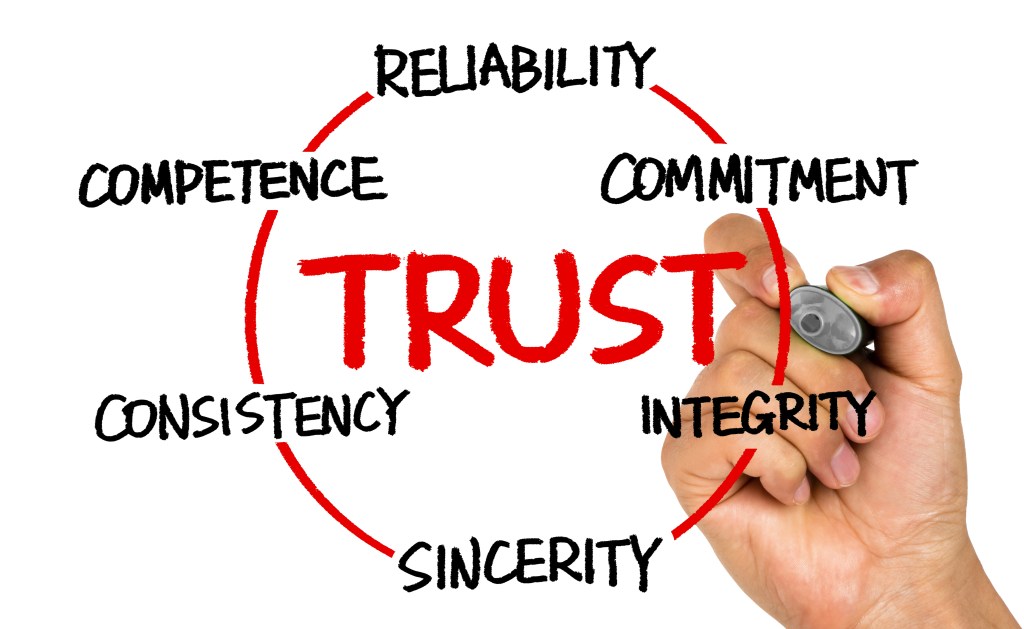
For many people, especially many I encounter as a therapist, trust is a difficult topic. I hear stories of broken trust over and over, which makes it difficult to trust again. This is because trust requires vulnerability. Vulnerability is risky because it requires opening up and the possibility of being hurt. However, never taking the risk to trust can lead to isolation, building up walls, and a lack of intimacy in relationships.
Even for someone who is trusting, it takes time to build trust with a therapist as well. While some people come to therapy ready to share all, it is more often I see a slow building up of trust in order to begin to feel safe. After all, therapy is a space for sharing things that are deeply personal and vulnerable. Some people have been hurt by trusting therapists, so understandably it would require more time to allow that trust to grow. Regardless of how long it takes, learning to trust is a valuable part of the therapeutic relationship and really any relationship in life.
Although people may always fail and break trust, there is one who we can always count on and put our trust in, our Lord and Savior. There are numerous places in Scripture which discuss trusting in God. One of my favorites is Isaiah 26:3, which says, “You will keep in perfect peace, him, whose mind is steadfast because he trusts in You.” Trusting in God allows us to gain His perfect peace. His peace is what can carry us through the challenges and painful times in life.
As previously mentioned, trust takes time to build. It is like planting a seed in the ground. Proper care will allow that seed to grow into what it is meant to become. The same is said of trust. It takes a willingness and if given the right environment, it can continue to grow and thrive. I encourage you, if trust is difficult, give it a chance and you never know what a little trust will grow in your life.
 Heritage Counseling Center Blog